
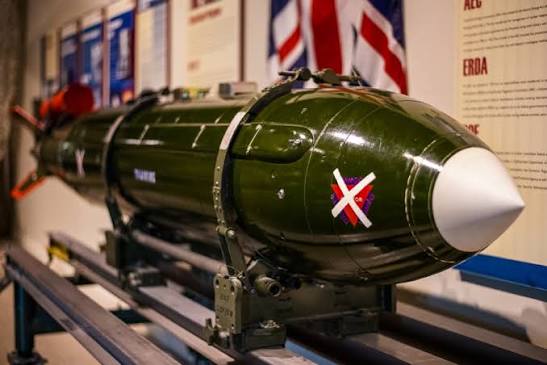
The W69 nuclear warhead stands as a significant artifact of Cold War history, representing a period of intense strategic competition and technological advancement in nuclear weapons design. Developed for the United States Air Force’s AGM-69 SRAM (Short-Range Attack Missile), the W69 was a compact and powerful thermonuclear weapon that played a crucial role in the U.S. strategic deterrent for two decades. While it was eventually retired and fully dismantled, its story encompasses technical achievement, safety controversies, and the complex process of arms reduction .
Design, Development, and Technical Specifications
Origins and Design Heritage
The W69 was designed in the early 1970s as a warhead for the AGM-69 SRAM, a supersonic, air-launched missile intended to be carried by U.S. strategic bombers like the B-52 Stratofortress, FB-111A, and later the B-1B Lancer . The design of the W69 is believed to be derived from the B61 nuclear bomb, another well-known and versatile weapon in the U.S. arsenal . This design lineage suggests the W69 shared key physics and engineering principles with the B61, adapted for the smaller and more demanding form factor of an air-to-ground missile. The missile was developed so that bombers could penetrate Soviet air defenses by firing the SRAM to suppress enemy radar and missile sites, clearing a path for the bomber or allowing it to strike targets from a standoff distance . Approximately 1,500 W69 warheads were produced, corresponding with the number of AGM-69 missiles built .
Physical Characteristics
The W69 was remarkably compact and lightweight, designed to be carried in substantial numbers by a single aircraft. According to specifications, the warhead had a diameter of 15 inches (380 mm), a length of 30 inches (760 mm), and weighed 275 pounds (125 kg) . This small size was a key design feature, enabling the AGM-69 to be a relatively small missile—just 14 feet (4.27 m) long with a diameter of 17.5 inches (0.44 m)—that could be carried internally or externally on bombers . For example, a B-52 could carry up to 20 SRAM missiles, significantly increasing its offensive capability .
Destructive Power
Despite its compact size, the W69 was a highly powerful thermonuclear warhead. Official sources and historical analyses estimate its yield at approximately 170 to 200 kilotons of TNT (710 to 840 terajoules) . Some sources provide a variable yield, suggesting a lower fission yield of 17 kilotons and a boosted fusion yield of 210 kilotons . This immense power placed the W69 in the category of strategic nuclear weapons, intended to destroy hardened military targets like missile silos or air defense installations .
Operational History and Safety Concerns
Entering the Stockpile
The W69 warhead entered the U.S. nuclear stockpile in 1972, providing a crucial capability for the Strategic Air Command . By being part of the fast and agile SRAM, the W69 was at the forefront of the U.S. strategy to maintain a credible and survivable nuclear force. The weapon was in active service throughout the 1970s and 1980s, a period marked by the high tensions of the late Cold War .
Emerging Safety Issues
By the end of the 1980s, serious concerns began to emerge regarding the safety of the W69 warhead. The primary issue was its lack of modern, enhanced safety features. Notably, the W69 did not incorporate a fire-resistant pit, the component containing the plutonium core . This design flaw raised the alarming possibility that in the event of an aircraft accident or fire, the conventional high explosives in the warhead could detonate or burn, potentially dispersing plutonium over a wide area. In the worst-case scenario, but considered far less likely, there was also a concern it could result in a nuclear explosion .
These safety vulnerabilities, highlighted in a 1990 report by the U.S. House of Representatives Committee on Armed Services, led to significant operational changes . In June 1990, then-Secretary of Defense Dick Cheney ordered that all SRAM-armed aircraft be taken off alert status . The missiles were removed from active service pending safety upgrades or replacement, effectively grounding a key element of the bomber fleet’s combat readiness . Further issues compounded the problems with the W69, as inspections in 1990 also found cracks in the rocket motors of the SRAM missiles, creating a risk of explosion upon launch . This multi-faceted crisis led to the decision to retire the entire W69/SRAM system.
Dismantlement and Legacy
The Retirement Process
The W69 was formally retired from the U.S. nuclear stockpile between 1991 and 1994 . The retirement was part of a broader shift in U.S. nuclear policy following the end of the Cold War. The need to reduce the size of the nuclear arsenal and modernize the remaining warheads with enhanced safety features made the W69 and its associated delivery system obsolete. In 1991, President George H.W. Bush also canceled the SRAM II program, which would have used a newer warhead (the W89) as a more modern and safer replacement for the W69 .
Dismantlement and Material Disposition
The physical dismantlement of the W69 warheads occurred in stages. The initial dismantlement of the primary components was completed by 1999 at the Pantex Plant in Texas . However, the more complex task of dismantling the canned subassemblies (CSAs)—the secondary stage of the thermonuclear weapon containing uranium components—remained .
These CSAs were stored until 2012, when the process began at the Y-12 National Security Complex in Tennessee . Y-12 was the very facility that had originally assembled them in the 1970s. The completion of this final phase of dismantlement in 2016 marked the definitive end of the W69’s life cycle . The dismantlement process is a crucial part of non-proliferation efforts; it not only ensures the materials cannot be misused but also allows for the recovery and recycling of valuable materials like uranium and plutonium. These recovered materials can be used for national defense purposes, such as in the Life Extension Program for other warheads or as fuel for the U.S. Navy’s nuclear-powered fleet .
Conclusion
The W69 nuclear warhead is a powerful example of Cold War technology, designed to ensure strategic parity through immense destructive power. Its history, from a cutting-edge design in the 1970s to a problematic system in the 1990s, illustrates the evolving understanding of nuclear safety and the shifting geopolitical landscape at the end of the Cold War. The ultimate and complete dismantlement of the W69, finalized in 2016, serves as a testament to the long and intricate process of arms reduction and the responsible stewardship of nuclear materials . While the W69 no longer exists as a weapon, its history provides valuable lessons in the lifecycle management of advanced military technology and the constant interplay between national security and safety.