
Watch ten minutes of a competitive volleyball match and you’ll notice something odd. Players sprint to new spots after almost every point, someone in a different colored jersey keeps subbing in and out Dbbet without a whistle stopping play, and the tallest person on the team sometimes never touches the ball near the net. None of that is random. It’s the volleyball positions doing their job, and once you know what to look for, the chaos turns into a pattern almost immediately.
I didn’t get this until I actually played a season of rec league. Before that, I assumed volleyball was just “hit it over the net” with extra steps. It isn’t. Every position carries its own job description, and the team only works if all six are doing something different at the same time.
Why volleyball positions confuse so many new players
Part of the confusion comes from rotation. Unlike basketball, where a point guard stays a point guard for the whole game, volleyball players physically rotate clockwise around the court every time their team wins back serve. So the person who was setting a minute ago might now be standing in the back row, and someone else has taken over that job for this rotation.
That single rule trips up more beginners than anything else. You’re not just learning a position, you’re learning how that position moves through six different spots on the court over the course of a game.
The six volleyball positions and what each one does
Here’s the breakdown, roughly in order of how visible they are to someone watching from the stands:
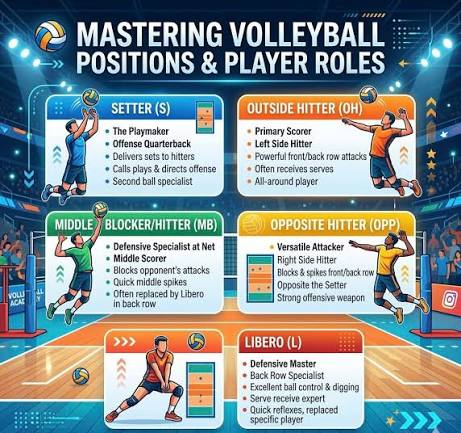
- Outside hitter (left side) — the go-to attacker on most teams, hits from the left front, and usually gets the most sets during a close match
- Opposite hitter (right side) — mirrors the outside hitter from the right, blocks the other team’s outside hitter, and steps up when the primary attack gets shut down
- Middle blocker — reads the opposing setter and tries to be at the net the instant the ball goes up, often the fastest attacker on the team even though they get fewer touches
- Setter — the on-court playmaker, touches the ball on almost every possession, and decides who gets to attack and when
- Libero — the back-row defensive specialist, wears a different colored jersey, and cannot rotate to the front row or serve in most youth and college rule sets
- Defensive specialist — a back-row substitute brought in for serve-receive or defense, similar to a libero but without the special jersey rules
Six positions, six completely different skill sets. A great libero can be a mediocre hitter and it wouldn’t matter, because that’s not their job.
The libero is the odd one out, and that’s the point
If you only remember one of these volleyball positions, make it the libero. It’s the position that makes the least sense on paper and the most sense once you’ve watched a full match.
The libero exists because coaches got tired of losing their best defenders to fatigue and injury from playing all six rotations, including at the net. So the rules created a specialist who plays only in the back row, subs in and out freely without counting against the substitution limit, and wears a jersey that has to be visibly different from everyone else’s. Referees need to spot that swap instantly.
What that buys a team is a player who can dive for balls all match without needing the size or jumping ability that front-row positions demand. Some of the best liberos in the sport are shorter than almost everyone else on the roster. Height stops mattering the second the ball drops below net level.
How volleyball positions rotate during a match
Rotation order matters more than most fans realize. Before serving, teams line up in a fixed order, and every time they win the serve back from the other side, everyone shifts one spot clockwise. That’s why a setter might spend part of a set in the back row, unable to attack from in front of the ten-foot line, before rotating back up front where the real setting work happens.
Coaches build entire rotations around covering weak spots. If a team’s worst passer ends up in the front row during serve-receive, opponents will target that seam on purpose. Reading the rotation, not just the score, tells you a lot about why a coach calls a timeout when they do.
What this actually means if you’re watching or playing
You don’t need to memorize every volleyball positions chart to enjoy a match, but knowing what the libero is doing back there, or why the setter suddenly can’t attack, turns a confusing scramble into something you can actually follow. Next time you watch a game, pick one player and just track where they go after each point. It’s a small habit, but it’s the fastest way to actually understand the sport instead of just watching a ball go back and forth.